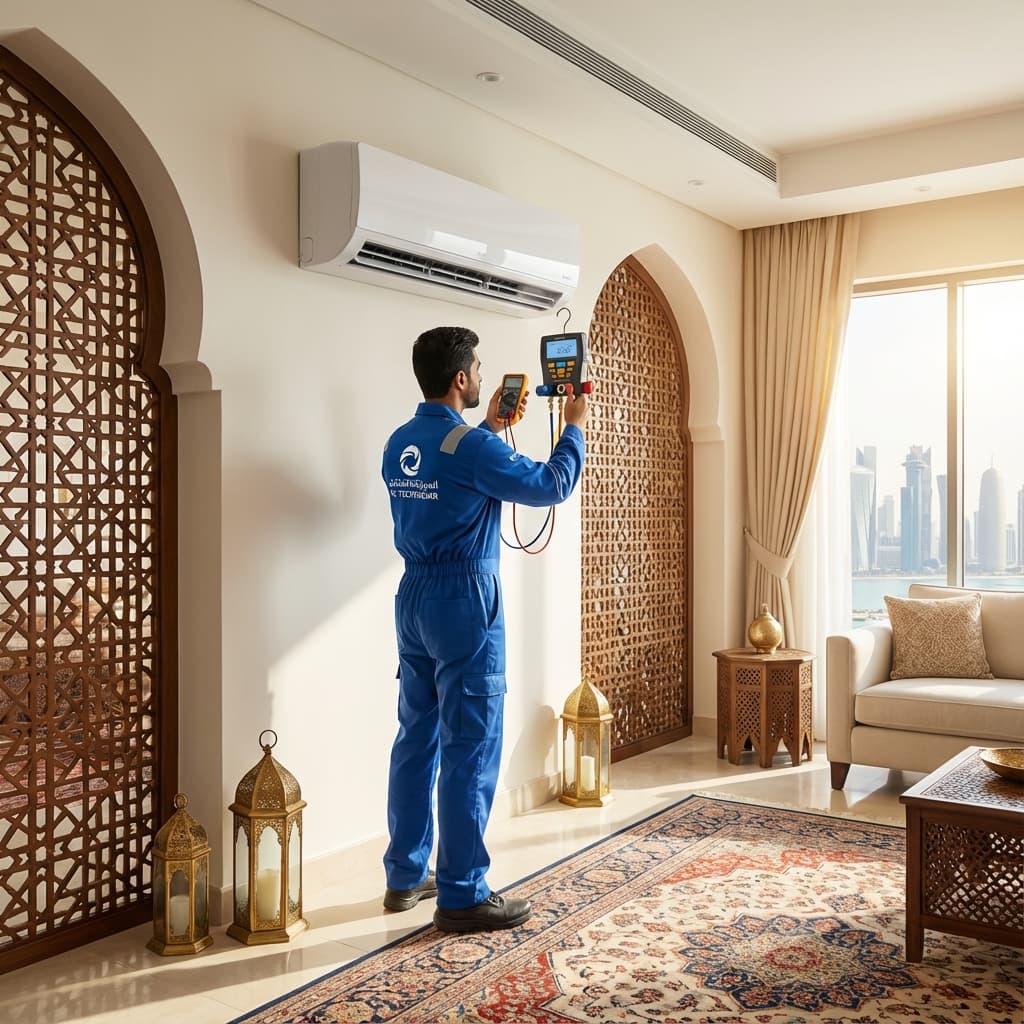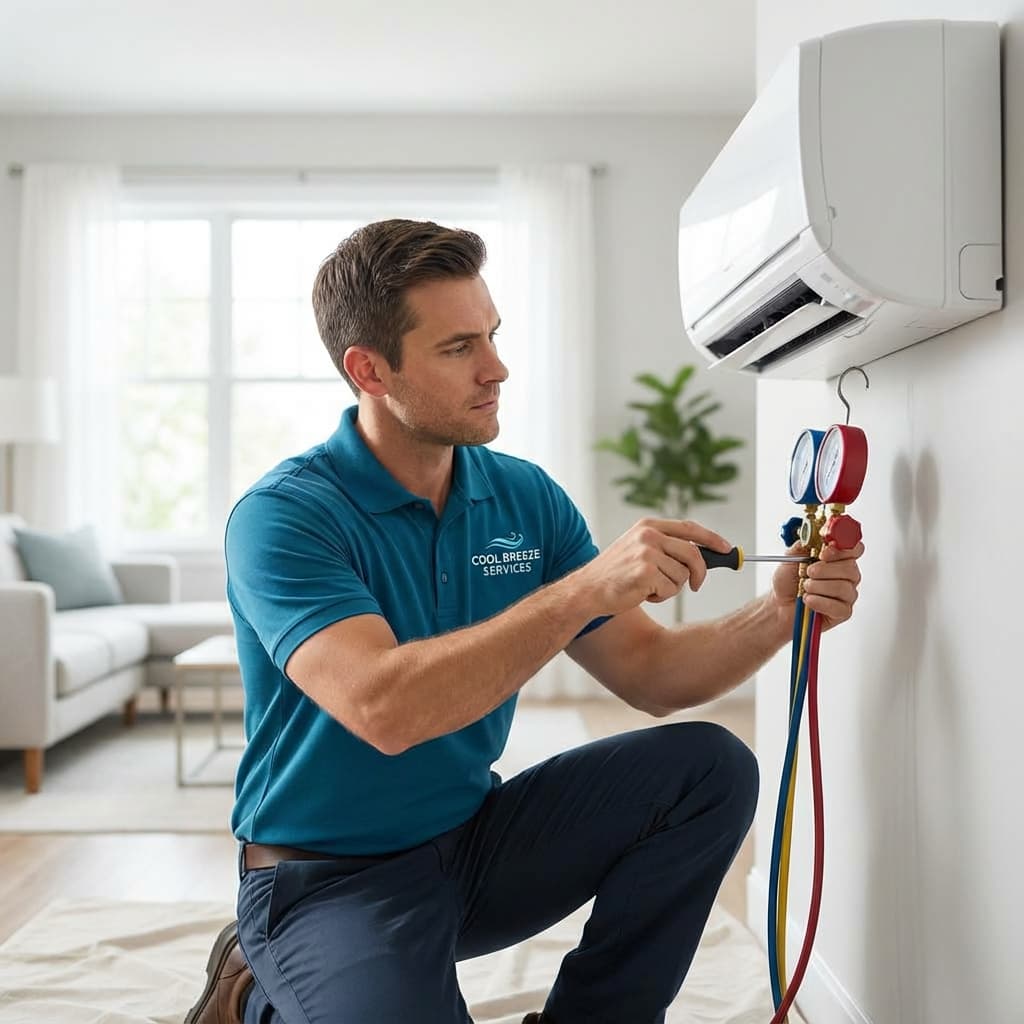
Midea air conditioners are widely installed across Qatar compounds, apartments, and commercial spaces. These units are known for their budget-friendly pricing and reliable cooling performance. However, the extreme summer heat in Qatar puts immense strain on these systems, leading to common component failures.
If your Midea split or ducted AC is showing error codes, blowing warm air, or dripping water, you need immediate help. This guide walks you through troubleshooting steps, common error codes, QAR repair costs, and landlord responsibilities. We cover all areas in Qatar, including Doha, Al Sadd, West Bay, Lusail, Al Wakrah, and Al Rayyan.
💬 Instant Midea AC Repair via WhatsApp
Is your Midea AC showing an error code or blowing warm air? Chat with our certified technicians on WhatsApp for quick help.
Chapter 1: Understanding Midea AC Systems in Qatar's Environment
Midea systems are engineered well, but they face unique challenges under Qatar's 50 °C summer temperatures. The heat index in Doha, particularly in high-density areas like Fereej Bin Mahmoud and Al Mansoura, requires continuous compressor operation. Without proper maintenance, this near-constant running leads to premature wear on capacitors and fan motors.
Dust is another major factor that affects Midea units in Qatar compounds, such as those in Al Waab and Abu Hamour. Desert sand accumulates on the outdoor condenser coils, acting as an insulating blanket that traps heat inside. This forced insulation raises refrigerant pressures, causing the compressor to draw more current and trip the circuit breaker.
Coastal areas, including Lusail Marina and The Pearl-Qatar, introduce salt corrosion challenges to outdoor units. Salt-laden humidity deposits on the condenser fins, causing galvanic corrosion that eats away the aluminum. This corrosion reduces heat transfer efficiency and can cause pinhole leaks in copper refrigerant lines.
Chapter 2: Deciphering Common Midea AC Error Codes
Modern Midea inverter ACs feature self-diagnostic microcontrollers that display error codes when a fault is detected. Knowing what these codes mean helps you understand the severity of the problem before calling a technician. Here is a breakdown of the most common Midea error codes encountered by Qatar residents:
1. Midea E1 Error Code: Communication Malfunction
The E1 error code indicates a communication failure between the indoor receiver board and the outdoor mainboard. This is common in older compounds in Al Rayyan and Al Gharafa where wiring insulation has degraded over time. Heat exposure and pest damage are typical causes of E1 communication faults.
When E1 appears, the indoor unit fan may run for a few minutes before shutting down completely. Technicians test communication voltages using a multimeter to locate the break in the signal wire. Replacing the communication wire between the units usually resolves the issue.
2. Midea E3 Error Code: Indoor Fan Speed Out of Control
The E3 code indicates that the indoor blower fan motor speed has fallen below target levels for more than 50 seconds. This is often caused by a failed indoor fan capacitor, a damaged blower motor, or a loose wire connection. A thick accumulation of dust on the blower wheel can also restrict rotation, triggering the E3 safety shut-off.
To diagnose E3, a technician checks if the blower wheel spins freely by hand when the power is turned off. If it spins freely, the motor winding or the starting capacitor on the control board is likely defective. Replacing the motor or board-mounted capacitor resolves the E3 error.
3. Midea EC Error Code: Refrigerant Leak Detection
The EC error code is a safety feature that shuts down the system when it detects a low refrigerant charge. Running an AC with low refrigerant can damage the compressor due to lack of lubrication and overheating. If EC appears on your display, turn off the AC immediately to prevent compressor seizure.
Low refrigerant is always caused by a leak in the system, typically at flare connections or copper joints. Our technicians use electronic leak detectors to find the source of the leak, repair it, and recharge the system with R-410A gas. Do not allow a technician to simply top up the gas without finding and repairing the leak first.
4. Midea F1, F2, F3 Error Codes: Sensor Faults
These codes indicate a fault with the temperature sensors (thermistors) inside the indoor or outdoor units. F1 relates to the indoor ambient temperature sensor, while F2 indicates a coil temperature sensor fault. F3 indicates a fault with the outdoor ambient sensor, which is common during extreme summer days in areas like Al Khor.
Sensors fail when their resistance drifts outside normal parameters due to age or moisture exposure. Replacing these sensors is a quick, inexpensive repair that takes less than 30 minutes. Always ensure the technician replaces them with genuine Midea parts to maintain compatibility.
Chapter 3: DIY Troubleshooting Steps for Midea ACs
Before scheduling a professional repair visit, there are several simple checks you can perform. Sometimes the issue is caused by a minor setting error that can be easily corrected.
Step 1: Check Thermostat Settings and Modes
Ensure your remote control is set to “COOL” mode, represented by a snowflake icon. If the remote is accidentally set to “AUTO”, “DRY”, or “FAN”, the outdoor unit will not start. Set the temperature to 22 °C or 24 °C and verify if the outdoor compressor starts running.
If the remote control screen is blank or faint, replace the batteries with fresh AAA cells. Low battery voltage can prevent the remote from transmitting signals to the indoor unit receiver. If the unit still doesn't respond, try using the manual power button located under the front grille.
Step 2: Inspect Circuit Breakers and Isolators
Go to your home's distribution board (DB) and check if the circuit breaker for the AC has tripped. If the breaker is tripped, push it fully to the “OFF” position, then flip it back to “ON”. Also check the outdoor isolator switch next to the compressor unit to ensure it is switched “ON”.
If the breaker trips again immediately when the AC starts, do not attempt to reset it a second time. This indicates a severe electrical fault, such as a short-circuit in the compressor or a failed fan motor. Leave the breaker off and schedule a professional inspection to prevent damage to your electrical system.
Step 3: Check and Clean Air Filters
A dirty, clogged air filter restricts airflow across the evaporator coil, causing it to freeze. When the coil freezes, the AC will stop cooling and may begin dripping water inside your room. Open the front panel of the indoor unit, slide out the mesh filters, and wash them with warm water.
Allow the filters to dry completely in the shade before sliding them back into their tracks. Never run your AC without filters, as dust will settle directly on the evaporator fins, clogging them. In Qatar's dusty environment, clean your filters every two weeks during the summer.
💬 Need Emergency Midea AC Service?
Our certified technicians are available 24/7 in Al Sadd, West Bay, Lusail, Al Wakrah, and Al Rayyan.
Chapter 4: Tenant vs. Landlord Responsibilities under Qatar Law
Deciding who pays for AC repairs is a common issue in Qatar residential leasing. Qatar Rent Law No. 4 of 2008 outlines the legal responsibilities of both parties. Understanding these rules helps prevent disputes and ensures repairs are handled quickly.
The landlord is legally obligated to maintain the property in habitable condition and handle structural repairs. This includes major AC repairs, such as replacing a failed compressor, repairing a damaged PCB, or replacing the entire unit. If the AC fails due to age or normal wear, the landlord must cover the cost of the repair.
The tenant is responsible for minor maintenance and repairs resulting from misuse or negligence. This includes cleaning the mesh filters regularly and replacing remote control batteries. If a repair is needed because the filters were never cleaned, the landlord may dispute the cost.
Most lease agreements in Qatar include a clause stating the tenant covers repairs up to QR 500. Under this clause, the tenant pays for minor repairs like capacitor replacements or drain flushes. The landlord covers any repair cost exceeding QR 500, such as compressor or fan motor replacements.
Chapter 5: Professional Midea AC Repair Costs in Qatar (2025)
Understanding typical repair costs in Doha helps you evaluate quotes from service providers. Here is a breakdown of estimated pricing for Midea split and ducted AC repairs in Qatar:
| Repair Type | Midea Split AC Cost (QAR) | Midea Ducted AC Cost (QAR) |
|---|---|---|
| Diagnostic Visit Fee | QR 50 – 100 | QR 150 – 200 |
| Capacitor Replacement | QR 120 – 220 | QR 250 – 350 |
| Refrigerant Leak Repair & Refill | QR 200 – 400 | QR 450 – 850 |
| PCB Mainboard Repair | QR 350 – 650 | QR 800 – 1,500 |
| Blower Motor Replacement | QR 250 – 450 | QR 600 – 1,100 |
| Compressor Replacement (2.0 Ton) | QR 1,200 – 2,000 | QR 2,200 – 4,000 |
Chapter 6: Localized Service Realities in Qatar Neighborhoods
The logistics of AC repair vary depending on your neighborhood in Doha. Each area has specific access requirements and environmental factors that affect servicing.
1. The Pearl-Qatar and West Bay High-Rises
Apartments in Porto Arabia, Viva Bahriya, and West Bay towers are connected to district cooling networks (like Qatar Cool). The FCUs in these apartments use chilled water actuator valves to regulate temperature. Technicians servicing these units must be trained to work on district cooling systems.
Most towers require work permits for technician entry. Service companies must submit commercial registrations, technician IDs, and insurance details to building security. Scheduling repairs in advance helps avoid delays at the security gate.
2. Al Rayyan, Al Wakrah, and Al Waab Compounds
Villa compounds in these areas are more exposed to desert dust and sand. This exposure means outdoor condenser units require regular pressure washing to maintain efficiency. High sand accumulation can block the unit's drain holes, causing rust and corrosion on the base pan.
Voltage drops can also occur in outer areas during peak summer months. These fluctuations can damage the AC's electronic control board. Using voltage stabilizers can help protect your system from electrical damage.
Chapter 7: Frequently Asked Questions about Midea AC Repair
Here are answers to common questions about Midea AC repairs in Qatar:
1. How long does a capacitor replacement take?
Replacing a run capacitor is a standard repair that takes about 30 minutes. Our technicians carry a stock of compatible capacitors in their service vans. This allows them to complete the repair during the first visit.
2. Can a Midea AC work with a smart thermostat?
Yes, Midea units can be integrated with smart thermostats (like Nest or Ecobee). This requires installing a 24V control interface adapter. Our technicians can install and configure these adapters to work with your smart home system.
3. Why is my Midea AC displaying an EC error code?
The EC code indicates that the system has detected a low refrigerant charge. This is a safety feature designed to protect the compressor from damage. Turn off the AC immediately and contact a technician to locate and repair the leak.
🚨 Contact ACQatars: +974 3395 6298
Our customer service team is available 24/7 to schedule emergency AC repairs in Doha, Al Sadd, West Bay, Lusail, Al Wakrah, and Al Rayyan. Message us on WhatsApp for a fast response.