Quick answer: AC compressor replacement in Qatar costs about 850–1,400 QAR for a typical 1.5–2.5 ton fixed-speed split AC, including brazing, a new filter drier, vacuum and fresh gas; inverter, 3-ton-plus and original-brand compressors cost more. Before paying, insist on a capacitor test (a 120–180 QAR fix), and replace the whole unit if it is old or runs on R22.
Key Takeaways
- Typical 2026 estimate: 850–1,400 QAR for a 1.5–2.5 ton fixed-speed split with a compatible T3-rated compressor; inverter and original-brand jobs cost more.
- Many “dead compressor” calls are really a failed capacitor (120–180 QAR), a burnt contactor, low gas or a dust-choked condenser.
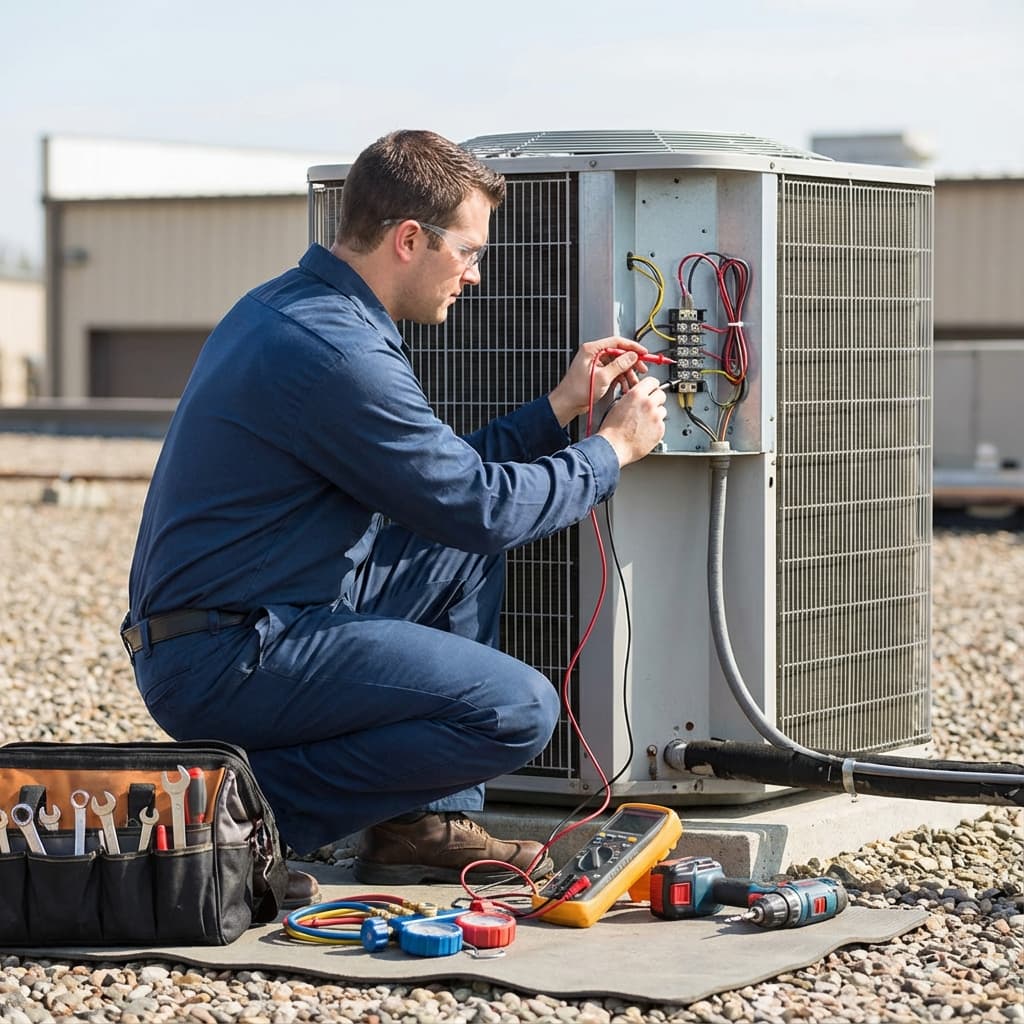
- A real diagnosis uses a multimeter, megohmmeter, clamp meter and gauges, not just a listen to the outdoor unit.
- Replace the whole AC if it runs on R22, is around 10 years old or more, or the repair costs over half the price of a new unit.
If a technician has just told you “your compressor is gone,” you are looking at the biggest repair bill a split AC can produce. This guide explains the real AC compressor replacement cost in Qatar for 2026, how to check whether the compressor has actually failed, and when buying a new unit makes more sense. It draws on our field work in Doha since 2004.
Our AC compressor repair and replacement service covers Al Sadd, West Bay, Lusail, The Pearl, Al Wakrah, Al Rayyan, Abu Hamour and the rest of Doha, 24/7.
💬 Told your compressor has failed? Get a second opinion
Send us your AC brand, tonnage and age on WhatsApp. We test the capacitor, contactor and windings before quoting for a compressor.
How Much Does AC Compressor Replacement Cost in Qatar?
AC compressor replacement in Qatar typically costs 850–1,400 QAR for a 1.5–2.5 ton fixed-speed split AC with a compatible, T3-rated compressor, fitted and gassed. Inverter, large-tonnage and original-brand compressors cost more. These are typical 2026 estimates; the final quote follows diagnosis.
| AC size and type | Compatible T3 compressor (fitted) | Original-brand compressor (fitted) | Typical job time |
|---|---|---|---|
| 1 ton split, fixed-speed rotary | 700 – 950 QAR | 1,000 – 1,400 QAR | 3 – 4 hours |
| 1.5 ton split, fixed-speed rotary | 850 – 1,100 QAR | 1,200 – 1,600 QAR | 3 – 4 hours |
| 2 – 2.5 ton split, fixed-speed rotary | 1,050 – 1,400 QAR | 1,500 – 2,100 QAR | 3 – 5 hours |
| 1 – 2.5 ton inverter split (DC rotary) | 1,300 – 2,000 QAR | 1,800 – 2,800 QAR | 4 – 5 hours |
| 3 – 5 ton split or ducted | 1,600 – 2,600 QAR | 2,400 – 3,800 QAR | 5 – 7 hours |
In short, budget 850–1,400 QAR for a typical 1.5–2.5 ton fixed-speed split, and expect original-brand inverter jobs to approach the price of a new unit.
What should the price include?
A fair compressor quote is a complete refrigeration job, not just a part swap:
- Recovering the remaining gas and removing the old compressor.
- Brazing with nitrogen flowing through the pipes, so no oxide scale forms inside.
- A new filter drier, since the old one is contaminated.
- A nitrogen leak test, then a deep vacuum to remove moisture and air.
- A weighed R410A or R32 charge, usually a new capacitor, and a test run with amp and pressure readings.
If a quote leaves out the drier, nitrogen or vacuum, it is cheaper for a reason. For comparison, a capacitor is 120–180 QAR, a gas refill 180–300 QAR and a PCB repair 250–450 QAR. The Peninsula once reported Doha workshops charging QR500–600 for a used compressor versus about QR1,200 for a new one (The Peninsula, 2017); prices have moved, but the used-part risk hasn’t.
How Do I Know If My AC Compressor Is Bad?
You can’t be sure without electrical tests, but these symptoms point strongly at the compressor:
- The outdoor fan spins but the compressor stays silent or only hums, and indoor air is room temperature.
- The breaker trips the moment the compressor tries to start.
- Loud knocking, grinding or metallic rattling inside the outdoor unit.
- The compressor runs but the AC won’t cool, and gas pressures barely change.
- A burnt, acrid smell, or dark, acidic oil at the service valve.
The catch: the first three symptoms are shared by parts costing a fraction of a compressor.
What Faults Look Like a Dead Compressor but Aren’t?
The most common look-alike is a failed run or start capacitor, which costs 120–180 QAR to replace, not 1,000 QAR or more. Rule these out first (typical 2026 estimates):
| What you notice | Often actually | How it’s proven | Typical fix cost |
|---|---|---|---|
| Hums, won’t start, trips after seconds | Weak or failed run/start capacitor | Capacitor reads below its rated µF on a meter | 120 – 180 QAR |
| Outdoor unit silent, indoor fan blowing | Burnt contactor or a loose, burnt terminal wire | Voltage check across the contactor and terminals | 150 – 250 QAR |
| Starts, runs a few minutes, cuts out, repeats | Overheating from a dirty condenser or low gas | Condenser check and gauges | 150–200 QAR wash, or 180–300 QAR gas plus leak repair |
| Inverter unit shows an error code, compressor never starts | Inverter PCB, power module or sensor fault | Error code, board output, winding test | 250 – 450 QAR |
| Compressor runs but the air is warm | Low gas from a leak | Pressure gauges and a leak test | 180 – 300 QAR plus leak repair |
| Breaker trips every time the AC switches on | Weak breaker, loose wiring or grounded compressor | Megger test and breaker check | Minor if wiring; see cost table if compressor |
The takeaway: a humming, non-starting compressor is a capacitor problem until a meter proves otherwise.
Read more about AC capacitor testing and replacement and why an AC keeps tripping the breaker.
Why We Test the Capacitor Before Condemning a Compressor
We test the capacitor first because it is the cheapest part that most convincingly imitates a dead compressor. A weak capacitor can’t give the motor enough starting torque, so the compressor hums, heats up and trips its overload, exactly like a seized one. In Doha, capacitors sit inside outdoor units baking in direct sun, and heat wears them down fast.
We have taken many second-opinion calls where the “burnt” compressor started immediately on a new capacitor. The reverse happens too: a new capacitor gets the unit running for a day, then it stops again because the compressor really was failing. So we never stop at the capacitor; we finish the winding, insulation and amp tests before giving a verdict.
How Does a Technician Confirm a Compressor Is Dead?
A technician confirms a failed compressor with electrical and pressure measurements, never by sound alone.
- Step 1: Check the supply. Measure voltage at the outdoor unit while it tries to start, ruling out a low supply, loose isolator or weak breaker.
- Step 2: Test the capacitor. Read its microfarad (µF) value with a meter and compare it with the rating on the label.
- Step 3: Inspect the contactor and overload. Confirm the contactor closes cleanly and the overload isn’t simply open because the compressor is still hot.
- Step 4: Measure winding resistance. On a single-phase compressor, Start–Run should equal Common–Run plus Common–Start, and an open (OL) or zero reading means a failed winding. On inverter compressors the three terminal pairs should read equal and low, typically 0.3–2.0 Ω (Fujitsu General).
- Step 5: Megger each terminal to ground. Test at 500 V DC between each terminal and the compressor body; Fujitsu treats anything under 1 MΩ as a fault and prefers over 10 MΩ (Fujitsu General).
- Step 6: Clamp the amps. Compare running current with the nameplate RLA; a compressor that holds locked-rotor current (LRA) and never turns is seized.
- Step 7: Read the pressures. If the compressor runs but suction and discharge pressures stay close together, its internal pumping parts are worn.
- Step 8: Find the cause. Check the condenser, gas charge, supply and oil condition, because a new compressor fitted into the same fault will fail again.
Should I Repair or Replace My AC?
Repair the compressor if the AC is under about eight years old, runs on R410A or R32 and is otherwise sound; replace the unit if it is old, on R22, or the repair costs more than half the price of a new one. The common 50% rule says that when a repair costs more than 50% of a new system’s price, especially on an older unit, replacement is generally recommended (Fixr). The US “$5,000 rule” (age multiplied by repair cost; replace above 5,000 dollars) is another starting point, not a verdict (CBS News).
Neither rule is Qatar-specific, but the logic holds. If a new installed split is quoted at 2,400 QAR and the compressor job at 1,300 QAR, the repair is over 50%, so lean towards replacing.
| Your situation | Recommendation | Why |
|---|---|---|
| Under 5 years old, still under warranty | Claim the warranty first | Many brands cover the compressor longer than the rest of the unit |
| 5 – 8 years, R410A or R32, coils in good condition | Repair with a compatible or original compressor | You keep a sound unit for a fraction of a new one’s cost |
| 8 – 12 years, repair over 50% of a new unit | Replace the AC | The rest of the system is near the end of its life too |
| Any age, running on R22 | Replace the AC | R22 is being phased out; its gas and parts keep getting scarcer |
| Corroded coils, repeated leaks or a second compressor failure | Replace the AC | Something in the system is killing compressors |
| Rented apartment or villa | Report it to the landlord in writing | Major repairs usually fall on the landlord, subject to the lease |
The rule we follow: repair a young, healthy R410A or R32 unit; replace an old, R22 or repeatedly failing one.
On the fence? Our guide to the top 10 signs you need a new AC in Qatar covers the other warning signs.
Should I Replace the Compressor on an Old R22 AC?
Generally no; put the money towards a new R32 or R410A system instead. Qatar is an Article 5 country under the Montreal Protocol, and Middle East Article 5 countries must stop using virgin HCFCs such as R22 by 2030 (ACR Journal). R22 gas and matching compressors are only getting scarcer.
What Causes AC Compressors to Burn Out in Qatar?
Overheating is the main killer: industry trainers name it the number-one cause of compressor failure (HVAC School, Don Gillis of Chemours), and Qatar summers of 45–50°C push outdoor units to their limits.
- Direct sun: rooftop and balcony condensers must reject heat into air already above 45°C.
- Shamal dust: dust storms clog condenser fins, so pressures and compressor temperatures climb.
- Low gas: returning cool gas also cools the motor in a hermetic compressor, so a leak leaves it running hot.
- Voltage problems: dips during peak summer load (report persistent supply issues to Kahramaa), loose terminals and undersized cables raise motor current.
- Short-cycling: an oversized unit, faulty thermostat sensor or constant on-off switching stresses every start.
- Poor installation: skipping the vacuum or brazing without nitrogen leaves moisture and scale that become acid and blockages.
How to prevent compressor failure
- Wash the outdoor condenser before summer and again after the shamal season.
- Clean indoor filters every two to three weeks in summer.
- Fix leaks instead of repeatedly topping up gas.
- Replace a swollen or weak capacitor early.
- Avoid rapid on-off switching, and shade the outdoor unit without blocking its airflow.
For service prices, see our AC maintenance cost guide for Qatar.
What Warranty Should I Expect on a Replacement Compressor?
Expect a written warranty covering both the compressor and the labour; at ACQatars, compressor replacements carry a one-year warranty. Used compressors often come with far less: one Doha workshop told The Peninsula it gave four months on used units (The Peninsula, 2017).
Who Pays for a Compressor Replacement, Landlord or Tenant?
In most Qatar rentals, a compressor replacement is a major repair that falls on the landlord, but your lease is the deciding document. Leases fall under Law No. 4 of 2008 on property rental together with the Civil Code, under which the tenant handles minor repairs unless agreed otherwise and must notify the landlord of urgent repairs (Gulf Times, Legal Purview). Report the fault in writing and keep the diagnosis report.
What Are the Red Flags in a Compressor Diagnosis?
The biggest red flag is a technician who declares the compressor dead without testing the capacitor.
- No readings: ask for the capacitor µF, winding ohms and insulation figures; a real technician will show you.
- Used compressors sold as new: some come from Industrial Area scrap yards, so check the box, label and serial number.
- No filter drier, nitrogen or vacuum in the quote.
- No invoice or warranty paper, cash only.
- Pressure to decide on the spot or to skip a second opinion.
- A new compressor quoted for an old R22 unit with no mention of replacing it.
Frequently Asked Questions
How much does it cost to replace an AC compressor in Qatar?
Replacing the compressor on a 1.5–2.5 ton fixed-speed split AC in Qatar typically costs 850–1,400 QAR in 2026, including brazing, filter drier, vacuum and gas. Inverter, 3-ton-plus and original-brand compressors cost more, and the final price follows diagnosis.
Can a bad capacitor be mistaken for a bad compressor?
Yes, a failed capacitor is the most common look-alike. Both make the compressor hum, fail to start and trip its overload. A capacitor costs 120–180 QAR to replace, so it should always be tested with a meter before anyone condemns the compressor.
How long does an AC compressor last in Qatar?
A well-maintained compressor usually lasts about 10–15 years, but Qatar’s 45–50°C summers, dust and long running hours often shorten that. Regular condenser cleaning, fixing gas leaks and replacing weak capacitors are the best ways to extend its life.
How long does AC compressor replacement take?
Most split AC compressor replacements take 3–5 hours on site, including brazing, nitrogen testing, vacuum and gas charging. Inverter units, large-tonnage systems and hard-to-reach outdoor units can take longer.
Does the landlord pay for AC compressor replacement in Qatar?
Usually yes, because a compressor is a major repair, but your lease decides. Qatar leases fall under Law No. 4 of 2008 and the Civil Code, which leave minor repairs to tenants. Notify your landlord in writing and keep the diagnosis report.
🚨 24/7 Compressor Diagnosis in Doha: +974 3395 6298
ACQatars has repaired ACs across Qatar since 2004. Call or WhatsApp for a full capacitor, winding and insulation test before you pay for a compressor, anywhere from Al Sadd and West Bay to Lusail, The Pearl and Al Wakrah.